The Price of Freedom

This Memorial Day is an opportunity to pause and reflect on the great sacrifices made by so many brave men, women, and the families who support them. This blog will always be tied to Memorial Day and remembering the actions of the 71st Infantry Regiment, recognizing that all the men of the 71st were part of a long line of patriots stretching into the past and reaching forward to today. “Thank you for your service” does not express the gratitude I feel deeply enough but I offer it to all our veterans.

From the “Awards” report for the 71st IR I’d like to introduce you to Staff Sergeant Stanley F. Scibek, one of my grandfather’s comrades-in-arms who never came home from France.

Staff Sergeant STANLEY F. SCIBEK, Company I, 71st Infantry, Silver Star (Posthumous), for gallantry in action against the enemy on 13 November 1944. Sergeant Scibek was leading his platoon into the town of Leintrey, France, through a barrage of mortar and artillery fire when machine-gun fire from a concrete pillbox impeded the advance of his scouts. Creeping and crawling warily to the flank of the pillbox, Sergeant Scibek rolled two hand grenades into it, killing its two occupants and putting it out of action. As a result of this courageous deed, the capture of Leintrey was greatly facilitated. As the platoon advanced upon Hill 310, its next objective, his scouts were again stopped by the enemy. Sergeant Scibek crawled forward and tossed another grenade which killed two more Germans and paved the way for his platoon to reach its objective. During this action, Sergeant Scibek was killed by enemy machine-gun and mortar fire. Sergeant Scibek’s courage, aggressiveness and fighting spirit exemplify the finest traditions of our Armed Forces.
Decoration Day
Sleep, comrades, sleep and rest
On this Field of the Grounded Arms,
Where foes no more molest,
Nor sentry’s shot alarms!
Ye have slept on the ground before,
And started to your feet
At the cannon’s sudden roar,
Or the drum’s redoubling beat.
But in this camp of Death
No sound your slumber breaks;
Here is no fevered breath,
No wound that bleeds and aches.
All is repose and peace,
Untrampled lies the sod;
The shouts of battle cease,
It is the Truce of God!
Rest, comrades, rest and sleep!
The thoughts of men shall be
As sentinels to keep
Your rest from danger free.
Your silent tents of green
We deck with fragrant flowers
Yours has the suffering been,
The memory shall be ours.
                              — Henry Wadsworth Longfellow

Retaking Rauwiller

November 26th

USA-E-Riviera-27

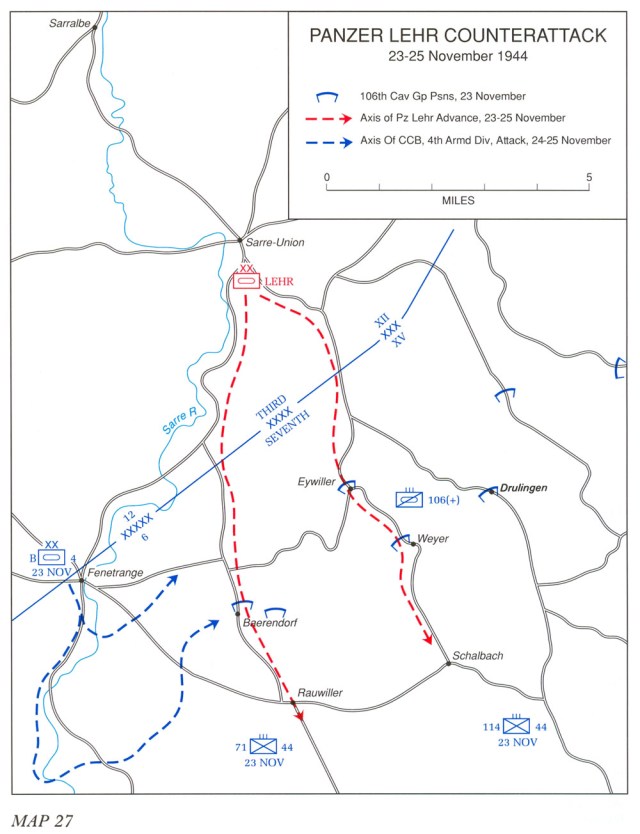
After stopping the advance of the Panzer Lehr Division, the 71st fell back from the front lines, returning to their former positions around Goerlingen and Kirrberg. The Regiment was recuperating and re-organizing after the intense fighting.

To the north, the 45th Division, which had passed through the 71st’s lines, and the 114th Regiment were pushing back against the Panzer Lehr and the 361st Volksgrenadiers. Increasing the pressure on Panzer Lehr, the 4th Armored Division, which had originally intended to cross the Saare River north of Fenetrange, had found the ground too soft and re-directed, moving south and then east from Fenetrange. This movement gave the American armor flanking positions to counter the German heavy armor.

As these friendly units begin to link up and the 71st Canon company continues pounding the Germans, they begin to fall back toward Sarre-Union. As they do, the 71st follows, occupying the towns they were ferociously defending two days prior.

November 27th

As the allied troops and armor begin pushing the Germans in a counter-attack of their own, they begin firing incendiary shells into the towns. This had the desired effect of rooting German infantry out of their sheltered positions; it likewise made Major Buschkamper’s hiding place in the attic no longer viable. Faced with staying put or burning to death, he made a dash through the flames and outside. Crawling for the next two hours in the shadows, he was able to evade the German occupiers and re-join the 71st in the pre-dawn hours of the 27th.

In preparation for a Divisional attack, third battalion began moving east from Rauwiller toward Kirrberg. The remainder of the Regiment continued re-consolidating, re-supplying and preparing to move forward. Throughout the 26th and 27th, the cold rain continued to fall throughout the region.

November 28th

The morning of the 28th found the Regiment moving north, following the advances of the 45 Division. Company G left their defensive position south of Rauwiller and marched through Baerendorf, Postroff, Exchwiller and Wolsthof. Company H joined up with 4th Armored Division and pushed through Eywiller, digging in north of town by day’s end.

November 29th

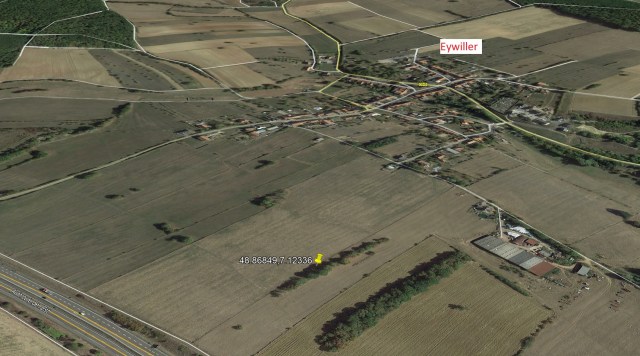
Canon company moved up to a new position just southwest of the town of Eywiller on high ground.

19441129CanonCompany

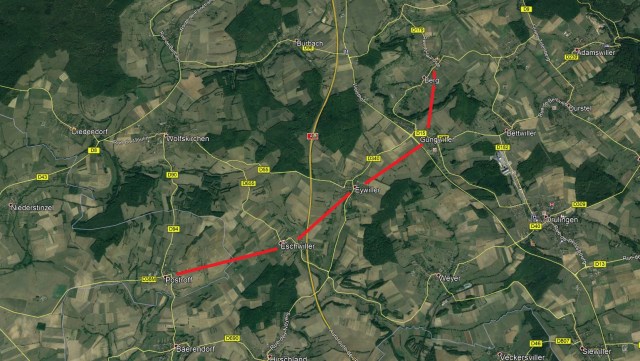
The 71st was now occupying a defensive line from Eywiller to Postroff. The anti-tank company moved into Postroff where they reported “many dead Germans in and around town”.

Company E reporting more men evacuated due to exposure and trench foot. Other companies reported the enemy shelling “the valley to our front [north]”.

November 30th

On the 30th several companies moved up, taking positions in Hirshberg and Gungwiller. The Regiment had filled in a defensive front running roughly north west from the town of Postroff to Berg.

19441130DefensiveLines

As the first full month of combat came to a close the reports do a bit of ‘wrapping up’. Of note were the following:

HQ Company received the “Combat Infantry Streamer” and the members of Company I received the Combat Infantryman Badge. On a more somber note, the Regiment reported the following statistics:

1288 enlisted men and 43 officers were reported as casualties. Of these, 485 were killed in action. 406 men were removed from combat due to trench foot – a direct result of the conditions they were fighting in. 94 men were listed as suffering from “combat exhaustion”, what we know today as PTSD.

As December came to the foothills, the 71st was about to take part in something that had never been done before; a military assault over the Vosges mountains in winter. Ahead of them lay the German border and the Maginot Line – with it’s defenses manned by Germans defending their soil and taking aim at the allied advance.