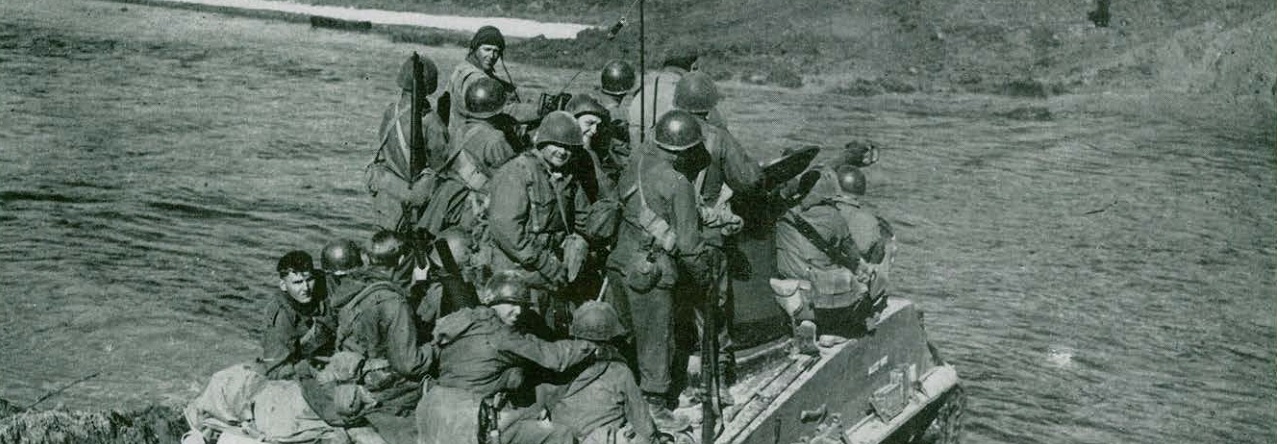
In the pre-dawn hours of November 13, the Regiment, along with the entire 44th Division, began offensive operations. The first objective for the 71st was to liberate the town of Leintery, the first major French town on the opposite (east) side of the Foret de Parroy. This would require the Regiment to leave their current dug-in positions within the forest and advance over open ground to what remained of Leintery’s farmhouses and buildings after weeks of artillery bombardment.
All companies, including those formerly in Regimental reserve, began the attack on the 13th with the Canon Company providing artillery support with special emphasis on company “I”.
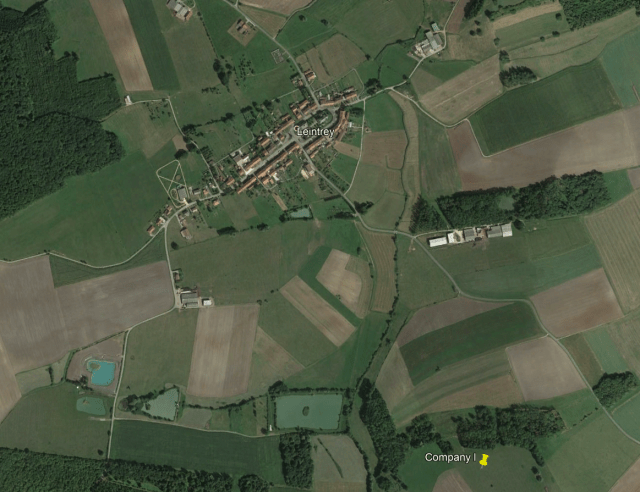
From the position above, Company I was able to move “back” to the north-west and take the town of Leintery. This took it’s toll as the Company report states that their commanding officer and “several” enlisted men (90 according to another source) were wounded during the assault.
The other Companies experienced varying degrees of success with several being pinned down by heavy German machine gun fire. Of note, Company “G” had several Germans surrender and come through their lines, a pattern which would repeat in the months to come.
November 14
The next morning found the 71st continuing the attack. This day, however, found them starting from different positions. Company “I”, after taking Leintery, moved to take high ground to the north and east identified as “Hill 310” where they were forced to wait for flaking support from other companies.
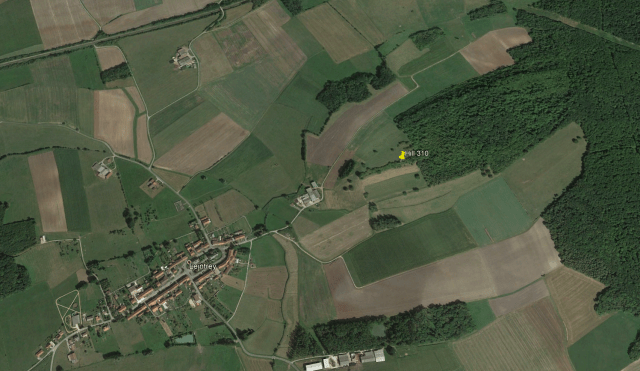
Company “K” had followed them through Leintery and were now advancing to shore up Company I’s position. As the fighting continued, Second Battalion’s HQ company “sent all available men to [be] litter bearers” for the wounded.
November 15th
As the next day dawned, the First and Second Battalions were largely in supporting roles as Third battalion continued to press the advance. By taking the high ground to the east of Leintrey, elements of the 71st had encircled the most fortified German positions. This also meant they were receiving fire from all sides. Company K, following Company I north and east into Leintrey, were now holding defensive positions in and around the village. They were also the link between Company I and re-supply and medical evacuation routes.
Key to the advance and the ability to hold the line at this point was the work of the Canon and Anti-Tank companies. From the top of hill 310, Company I was able to direct artillery fire on the hardened German positions. The engineers of the Anti-Tank company were tasked with locating and disarming the extensive minefields the Germans had established long before the 71st arrived. These demolition operations were often carried out under withering machine gun, mortar and small arms fire from the defending German lines.
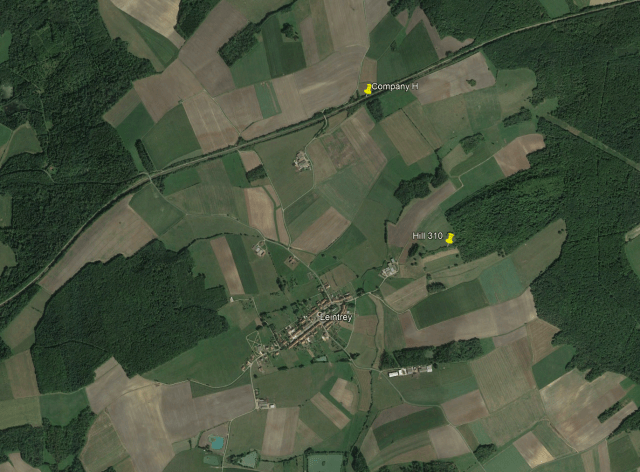
All of the Division’s companies along the front had continued to press the defending Germans back through the woods and consolidate their positions to form the new front about a mile to the east of Leintry. Company H, for example, had been able to move along the railroad tracks to the north of Leintrey and were now in a supporting position for Company I.
On November 16th, the 71st HQ company moved from Embermenil to Leintrey, signalling that the ‘front’ was firmly established to the east of Leintrey. The next few days will see the Regiment and the entire 44th Division push east again. The winter weather in the Vosges foothills had started to set in and many of the 71st began to suffer from trench foot, an “immersion foot syndrome” caused by poor footwear, wet feet, bad hygiene and cold temperatures. 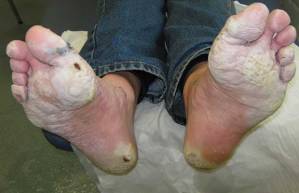 The men afflicted by this condition had to be pulled off the line, warmed up, cleaned up and treated until the skin had healed. In extreme cases, the dead skin would need to be surgically removed. By all accounts, it was a painful condition as the circulation and feeling returned to the affected areas.
 Pro Aris et Pro Focis