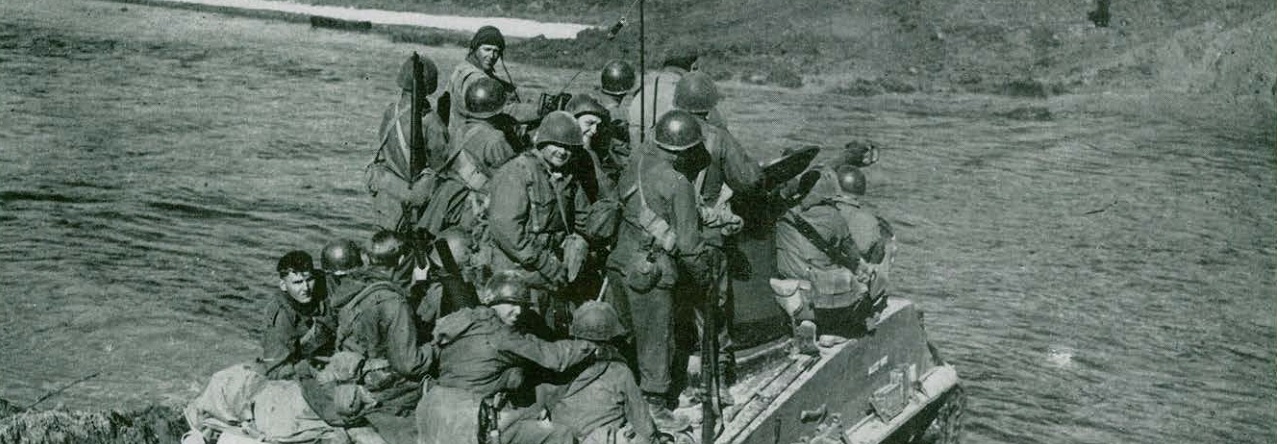
As November begins the reporting from all the companies takes on a much more detailed tone. I suspect that once the regiment took up the former defensive positions of the 79th, they were able to settle into a routine and each company’s secretary found his rhythm for reporting. It is interesting that, even in this context, some companies had much more ‘verbose’ entries compared to others. As the rain continued to saturate the 71st, it also ‘seeps’ through the reporting when companies casually mention they have been “on the line for 11 days” or “the men still haven’t had a hot meal.”
It’s also useful to note that the 71st Regiment was composed of three Battalions. Each Battalion had four rifle companies and one “headquarters” company. Companies A-D were 1st Battalion, companies E-H were 2nd Battalion and I-M were 3rd Battalion. There was no “J” Company. The Regiment’s Headquarters Company, Cannon (artillery) Company, Anti-tank Company and Medical Detachment operated independently and in support of the combat Battalions.
On November 1st, the First Battalion companies were occupying positions in and around the west side of the Foret de Parroy.
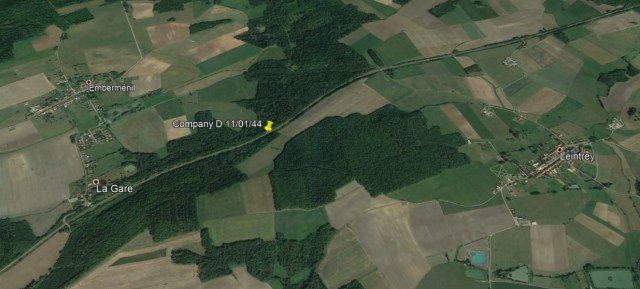
The position of Company D is shown above and is notable because their report from Nov 1st describes the Germans using a loudspeaker to to address them with “Welcome 44th. War is hell. Come over to our lines and get a hot meal. Ask the 79th Division; they can tell you about it”. According to Company A and the official Regimental History, the reply to the offer was a barrage of artillery and mortar fire.
Nov 2nd
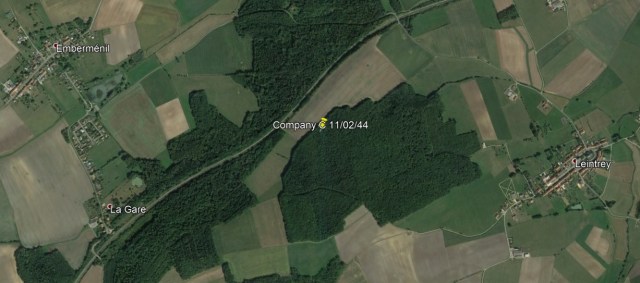
Bravo company reported that they were within 75 yards of enemy positions. They also reported another broadcast from the Germans, similar to the one on the preceding day, but accompanied with music. Charlie Company (position shown below) confirmed the loudspeaker broadcast.
 For the first time in the reports we have a direct enemy attack on the 71st. The HQ Company of 2nd Battalion reported a tank attack with heavy artillery fire. The attack was broken up by friendly artillery.
Easy Company bore the brunt of a sustained (90 minute) enemy artillery and mortar barrage. Two of the company medics went to the aid of wounded Tank Destroyer crewmen. Company E also sent out a combat patrol that engaged the enemy near a forward German observation post.
Elements of 1st Battalion (Companies A through D) started moving into position for attack during the early morning of Nov 3rd.
Nov 3rd
Reading between the lines of the reports, both the 71st and the opposing German forces were hindered by weather. Companies reported very few aircraft, and stated it was hard to use binoculars. There were some successes in spite of the conditions as the Cannon Company fired a 100-round barrage on the town of Reillon where the “enemy had vehicles parked bumper-to-bumper” and the barrage was “very effective”.
The entire 1st Battalion began advancing on enemy positions overnight and into the early hours of the 3rd, marking the Regiment’s first offensive operations. The primary objective was advancing over the open ground between Embermenil and the Foret de Parroy.
Company A began by sending out a reconnaissance patrol at 20:00 on the evening of the 2nd and by 08:00 the next morning the company’s 1st and 2nd platoons had moved into former enemy positions.
Company B also began advancing on the evening of the 2nd. They reported an enemy counter-attack but held their positions. Companies C and D also moved forward on the morning of the 3rd and gained ground, digging in to former German positions. Company D made preparations for an expected enemy counter-attack.
The 2nd Battalion also moved up. Company E sent a combat patrol out at 03:00 on the morning of the 3rd. Encountering no resistance, the Company was able to advance nearly 2000 yards. Their forward observation post noted a large column of troops, tanks and artillery headed toward Leintrey. They took enemy mortar fire in their new positions but dug in. Company F also advanced 1000 yards east, taking enemy small arms fire.
Nov 4th
Both 1st and 2nd Battalions spent the day consolidating positions taken during the previous day’s advance and enduring enemy artillery barrages that were heavy at times. Company E mentioned that they heard enemy tank movement overnight. German snipers were very active in the forest and Company B reported they were doing “everything possible to clear them out.”
Nov 5th
The new positions in the woods necessitated some new logistics and First Battalion’s A and P (Ammunition and Pioneer) platoon was busy blazing new supply and medical evacuation routes through the woods.
Company A sent out a night patrol and located the enemy motor park, a forward observation post, and troop assembly area. The weather cleared for a bit as Company B was strafed by enemy aircraft and they observed air combat taking place above them. Company E seemed to have the worst of it on this day as they were subjected to a 20-round mortar barrage which hit their machine gun section. Company G’s MG section was sent to the front line to relieve them.
Nov 6th
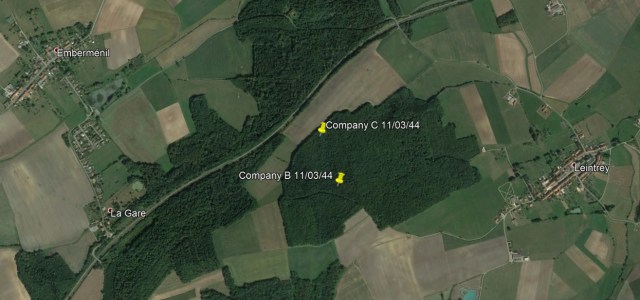
All the Regiment’s units reported a fairly quiet day with little enemy artillery. Men used the time to fortify their positions and tend to equipment. Positions of the various companies noted below:
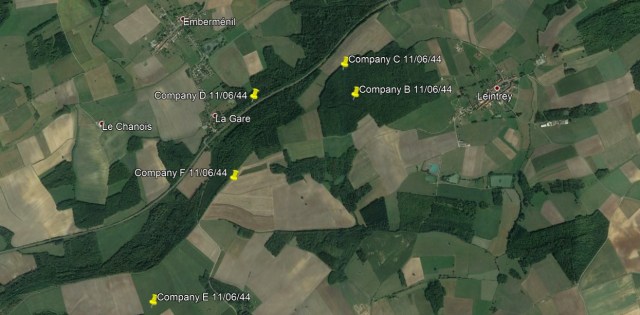
Nov 7th
The cold rain returned and the reports note that foxholes were flooding and caving in. General Dean and Lt. Col. Bedle visited Company B’s command post. Other sources indicate this was to reassure the men and let them know they were about to attack Leintrey. Second Battalion companies were relieved by Third Battalion. Reports indicate rain was a downpour and vehicles were bogged down meaning some companies were forced to march to the front lines.
Nov 8th
The rain continued, although several companies mentioned enemy planes strafing their positions. There were conflicting reports over one or two planes being shot down. There was no mention of the specific type of aircraft. As with previous reports, the rain continued to cause foxholes to cave in and made vehicular movement difficult. Enemy artillery was heavy in several areas of the lines and Company D was forced to abandon a mortar OP (observation post) due to an effective barrage.
Nov 9th and 10th
The rain continued to fall on the men and Company C reported their men had been in wet clothes and without sleep for 48 hours. There were reports of light to moderate artillery and mortar fire from the enemy. The 71st counter-batteries were heavy and effective with one report stating it was a “10 to 1” exchange. Both the 71st and the opposing German forces were in largely static positions.
Nov 11
The 71st spent the 11th making preparations to push east on the Germans. Company B sent a patrol to investigate the town of Leintrey which they searched thoroughly. Several companies reported enemy planes over their position and strafing.
Nov 12th
All the companies reported a devastating artillery bombardment of enemy positions that started around 19:00. One company reported they unloaded “about everything in the books”. There was little retaliation from the enemy. Company D had a rather ominous report noting they were “making preparations for the coming attack”. Company K’s XO and Communication Sergeant went on reconnaissance to forward assembly in preparation for the next day’s attack and the rest of the company started moving up by platoons.
The next day, November 13th, the 71st would participate in a Divisional attack to begin the march east toward Germany.
 Pro Aris et Pro Focis